How to Take a Digital Sabbath: A Practical Guide to a Day Off Screens
How to take a digital sabbath — a weekly day off screens. Why it works, how to prepare, what to do instead, and how to keep it going week after week.
Most of us now touch our phones more often than we touch anyone we love. We check them before we are fully awake and after we have meant to go to sleep. We reach for them in queues, at red lights, in the gaps between sentences, at the dinner table, in the bathroom. Very few people chose this. It happened to us gradually, one convenience at a time, and now the device that was supposed to serve our attention mostly spends it.
The digital sabbath is an old idea in a new costume. Every lasting culture built a weekly day when ordinary work stopped — we have written about this in The Rhythm of the Week. A digital sabbath applies the same wisdom to the newest form of work: the endless, low-grade labour of checking, scrolling, replying, and consuming.
This guide covers what a digital sabbath is, why it helps, how to prepare for one, what to do with the time, and how to keep the practice going — whether you take it for religious reasons, for your mental health, or simply because you would like your Sundays back.
What is a digital sabbath?#
A digital sabbath is a regular, intentional period — usually one day a week — during which you step away from screens and digital devices in order to rest, be present with people and places, and reconnect with what matters. It is typically twenty-four hours long, often from sunset to sunset or from waking to bedtime, and it can be strict (no screens at all) or partial (no phone, no social media, no email).
The word sabbath comes from the Hebrew Shabbat, from a root meaning to cease or rest. The Jewish Sabbath runs from sunset on Friday to nightfall on Saturday; the Christian Sabbath traditionally falls on Sunday. The rabbi and philosopher Abraham Joshua Heschel famously called the Sabbath "a palace in time" — a space built not of stone but of hours. A digital sabbath borrows that architecture, whether or not you share the faith that built it.
The modern movement has several roots. Since 2010, the National Day of Unplugging, begun by the Jewish nonprofit Reboot, has invited people to put devices away for one day each year. The filmmaker Tiffany Shlain, whose family has kept a weekly "Tech Shabbat" for years, wrote about the practice in her book 24/6. And countless families, churches, and individuals have quietly invented their own versions.
Why take a digital sabbath?#
Because rest requires an absence#
You cannot rest while you are still on call. Even when nothing urgent arrives, the possibility of a message keeps part of the mind alert, scanning, half-working. A day without devices removes that possibility, and for many people it is the first time in years that the nervous system is genuinely off duty. We have written about the grammar of rest — rest as a different language, not merely the absence of work.
Because attention is the substance of a life#
What you attend to, over time, is what your life becomes. When a large share of waking attention goes to feeds designed to hold it, a large share of life goes with it. A weekly day off screens is a way of reclaiming that attention, at least once in seven. Our long essay on the economy of attention explores why this matters so much.
Because the evidence, though young, points the same way#
Research on screen breaks is still developing, and studies vary in quality. But several controlled experiments have found that reducing social media use — for example, limiting it sharply for a few weeks, or taking a one-week break — improves people's reported wellbeing and reduces feelings of loneliness, anxiety, or depression in the short term. A digital sabbath is a gentler, regular version of the same intervention.
Because people deserve your whole face#
A phone on the table changes a conversation, even when it stays face down. One day a week without devices is one day a week when the people you live with get your undivided presence — and you get theirs.
Because boredom is useful#
The empty hour, when nothing is happening and nothing is being consumed, is where daydreams, ideas, and quiet self-knowledge have always come from. We have almost abolished it. A digital sabbath brings it back. See To Be Bored on Purpose.
How to take a digital sabbath: step by step#
1. Choose your day and your hours#
Pick one day a week that you can protect most of the time. For many people this is Saturday or Sunday; for others, a weekday off works better. Then choose the boundaries:
- Sunset to sunset follows the Jewish rhythm and has a beautiful logic: the sabbath begins in the evening, with a meal and a slower night, and you wake already inside it.
- Waking to bedtime is simpler for most families.
- A half-day — say, Sunday morning until mid-afternoon — is a good way to begin if a full day feels impossible.
Start with what you can actually keep. A half-day kept every week is worth far more than a full day attempted once and abandoned.
2. Decide what counts#
Be clear with yourself in advance, or every temptation becomes a negotiation. Some common levels:
- Strict: no screens of any kind — no phone, computer, tablet, television, or games.
- Phone-free: the phone is off and put away; a film with the family in the evening is allowed.
- Feed-free: no social media, news, email, or messaging apps; calls and maps are allowed.
There is no correct level. Many people begin with feed-free, move to phone-free after a few months, and occasionally try strict. What matters is that the rules are decided in advance, in calm, rather than in the moment, when the itch to check is strong.
3. Plan for the genuine exceptions#
Most people's real worry is emergencies. Plan for them:
- Tell close family how to reach you (a landline, a partner's phone, or a short list of contacts allowed through Do Not Disturb).
- If you are a carer or on call, keep the phone in a drawer with only emergency calls permitted.
- Write down any information you might need — addresses, directions, a recipe — on paper the day before.
The point is not to become unreachable in a crisis. It is to stop being reachable for everything else.
4. Prepare the day before#
A digital sabbath goes much better with a little preparation:
- Tell people. A short note to friends, family, or colleagues — I'm offline on Sundays; I'll reply on Monday — removes most of the anxiety. An email auto-reply helps.
- Finish the loops. Reply to anything that genuinely cannot wait.
- Download nothing. Resist the temptation to pre-load podcasts and films; that defeats the purpose.
- Buy an alarm clock. If your phone is your alarm, it will be in your hand within seconds of waking. A simple bedside clock solves this for good.
- Plan one or two things. Not a schedule — a walk, a meal with friends, a book. An empty day with no ideas at all can lead straight back to the screen.
5. Put the devices away — physically#
Willpower is unreliable; distance is not. Turn devices fully off and put them out of sight: a drawer, a basket by the door, a cupboard in another room. Some families keep a box with a lid. The ritual of putting them away matters. It marks the threshold, much as lighting candles marks the beginning of Shabbat.
6. Begin with a small ritual#
Mark the start of the day deliberately. Light a candle at the evening meal. Take a walk. Read a poem aloud. Say a short blessing — we have written about blessing the day. A threshold tells the body and mind that this day is different.
7. Fill the day with presence, not just absence#
A digital sabbath is not only no screens. It is yes to other things. See the list below for ideas.
8. End gently, and notice#
When the day ends, do not grab the phone and binge. Turn it back on deliberately. Before you look at anything, take a minute to notice how you feel. Then, at least for the first few weeks, write down one or two lines: What was hard? What was good? What did I miss, and what did I not miss at all?
What to do on a digital sabbath#
Some ideas, roughly in order of how much they tend to help:
- Walk. Alone or together, without headphones. A long walk is the classic sabbath activity for a reason. Try walking meditation, or simply the evening stroll our great-grandparents took for granted.
- Eat slowly with other people. Cook something that takes time. Invite friends. Let the meal run long. See The Table of Many Faces.
- Read a physical book. Something that asks for attention. Our guide to reading as a spiritual discipline has suggestions on how.
- Go outside. A park, a forest, a beach, a garden. Notice the season and the weather.
- Make something with your hands. Bake, draw, garden, knit, repair, play an instrument. See Hands as Instruments.
- Play. Board games, card games, football in the park, hide and seek with children.
- Attend worship or sit in silence. Go to a service, a meeting, a meditation group — or sit quietly at home.
- Write. A letter by hand, or a page in your journal. Our spiritual journaling prompts can help.
- Nap. Without guilt. Rest is the point.
- Do nothing. Sit on a bench. Watch the light move across a wall. Let yourself be bored.
What tends not to work: spending the day doing errands and chores you have saved up. That turns the sabbath into a different kind of work. Keep it for rest, people, nature, and things you love.
What to expect in the first few weeks#
Week one: the itch#
Most people are startled by how often they reach for a phone that is not there — dozens of times in the first few hours. You may feel restless, anxious, or bored. This is the habit loop firing without its reward. It is uncomfortable and completely normal.
Weeks two to four: the settling#
The phantom reaching becomes less frequent. Afternoons start to feel longer. Many people report that conversations deepen, sleep improves on sabbath night, and Monday feels less like an ambush. Some notice their weekday phone use dropping slightly as well.
After a few months: the protection#
The day becomes something you defend rather than endure. People who keep a digital sabbath for a long time often describe it as the best day of their week — and say they would no sooner give it up than give up sleep.
Making a digital sabbath work with family#
- Involve everyone in setting the rules, especially teenagers. Imposed rules are resisted; shared rules are owned.
- Adults go first. Children notice instantly if parents are exempt.
- Plan a shared anchor — a big breakfast, a family walk, a games evening — so the day has a centre.
- Allow different levels. A teenager might keep music but not social media; a parent on call might keep emergency calls only.
- Talk about it afterwards. What did everyone enjoy? What should change?
If a full day is impossible#
Begin smaller. Any of these is a real practice:
- A phone-free morning, from waking until noon, once a week.
- A digital sunset: all devices off from 8pm until morning, every evening. This pairs well with a proper evening routine — see Evenings as Architecture and our guide to sleep.
- A phone-free walk each day.
- Screen-free meals, every meal, for everyone.
- One digital sabbath per month, built up to weekly over time.
We have written more broadly about other kinds of abstinence — from news, from input, from noise — in Fasting in an Age of Input.
Common obstacles#
"I need my phone for work"#
Most jobs do not truly require constant weekend availability; they have simply drifted into expecting it. Talk to your manager about a predictable offline day. If you genuinely are on call, keep a partial sabbath — calls only — and protect the rest.
"I'll miss something important"#
You will occasionally miss something. Almost nothing that arrives on a phone on a Sunday is both urgent and unable to wait until Monday — and the people who truly need you know how to reach you. What you will gain is harder to measure and far larger.
"I get bored"#
Good. Boredom is the doorway. Stay with it a little longer than is comfortable, and see what wants to happen. Most people find that boredom gives way, within an hour or two, to something more interesting.
"I keep slipping"#
Then the rules may be too ambitious, or the day too empty. Lower the bar to something you can keep, plan one anchor activity, and put the phone further away. Slipping is information, not failure.
Frequently asked questions#
What is a digital sabbath?#
A digital sabbath is a regular period — usually one day a week — when you deliberately step away from screens and digital devices to rest and be present. It is inspired by the religious practice of keeping a weekly sabbath, but people of any faith or none can practise it.
How long should a digital sabbath be?#
A traditional sabbath lasts twenty-four hours, often from sunset to sunset. Many people begin with a half-day or a phone-free morning and build up. The best length is the one you can keep consistently.
Can I use my phone for emergencies on a digital sabbath?#
Yes. Most people keep emergency calls available — for example, by allowing calls from family through Do Not Disturb, or keeping the phone switched on in a drawer. The aim is to stop being available for everything, not to be unreachable in a crisis.
What can I do instead of using screens?#
Walk, eat slowly with friends or family, read a physical book, spend time in nature, make something with your hands, play games, attend worship or sit in silence, write letters or journal, nap, or simply do nothing for a while.
Does a digital sabbath actually help mental health?#
Research is still developing, but several studies have found that taking breaks from social media, or sharply limiting its use, improves reported wellbeing and reduces loneliness and anxiety in the short term. Many people also report better sleep, deeper conversations, and a calmer mind. A digital sabbath is not a treatment for mental-health conditions, but it can be a helpful part of a healthier rhythm.
Is a digital sabbath religious?#
It can be, but it does not have to be. The idea comes from the Jewish and Christian sabbath, and many people of faith see it as part of keeping that day holy. Others keep it for purely practical reasons — rest, focus, family time, mental health.
A final word#
Six days a week, the world will gladly take as much of your attention as you give it. The seventh day is an act of quiet refusal: a day when your attention is not for sale.
It will feel strange at first. Your hand will reach for a phone that is not there. The afternoon will feel unaccountably long. And then, somewhere in the second or third week, you may notice something you had forgotten — the particular texture of an unhurried day, a conversation that wanders where it likes, a mind that has, for once, been left alone.
May your seventh day be wide and unhurried. May the people you love have your whole face. May you remember, once a week, that you were never meant to be always on.
Affiliate link · we may earn a small commission
Hatch · sleep
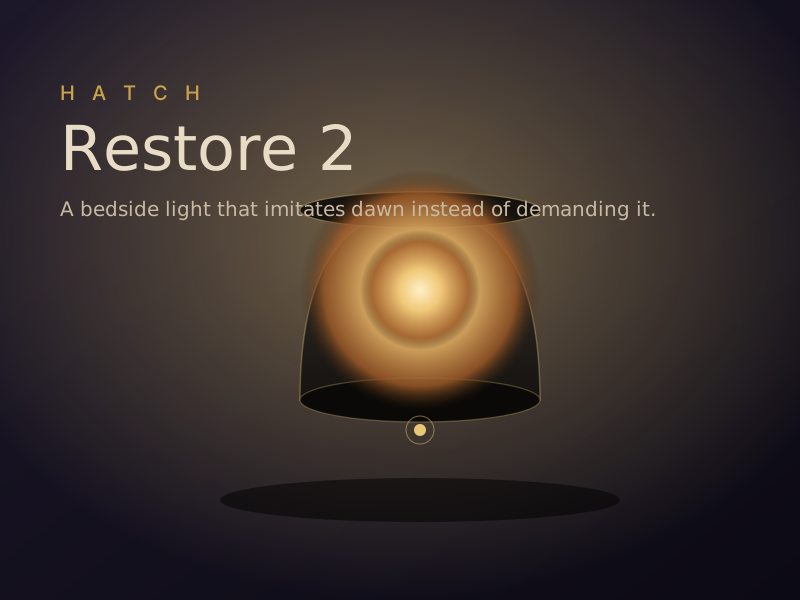
Hatch Restore 2 Sunrise Alarm
A bedside light that imitates dawn instead of demanding it — for people whose mornings have been too loud for too long.